

The 1975 biographical crime drama film Dog Day Afternoon wasn’t the first film to explore the media’s role in turning criminals into celebrities, as previously seen in Badlands, or to predict how dangerous and influential the media would become, as seen in Ace in the Hole and A Face in the Crowd. However, it was the first film to explore the compulsive need that everyone has to be in on the fun of watching a spectacle, in this case, the aftermath of a bungled bank robbery in Brooklyn. As cameras and onlookers gather outside the bank in growing numbers, the so-called hostages inside the bank run a gamut of emotions, from fear to morbid curiosity to eventually becoming cheerleaders.
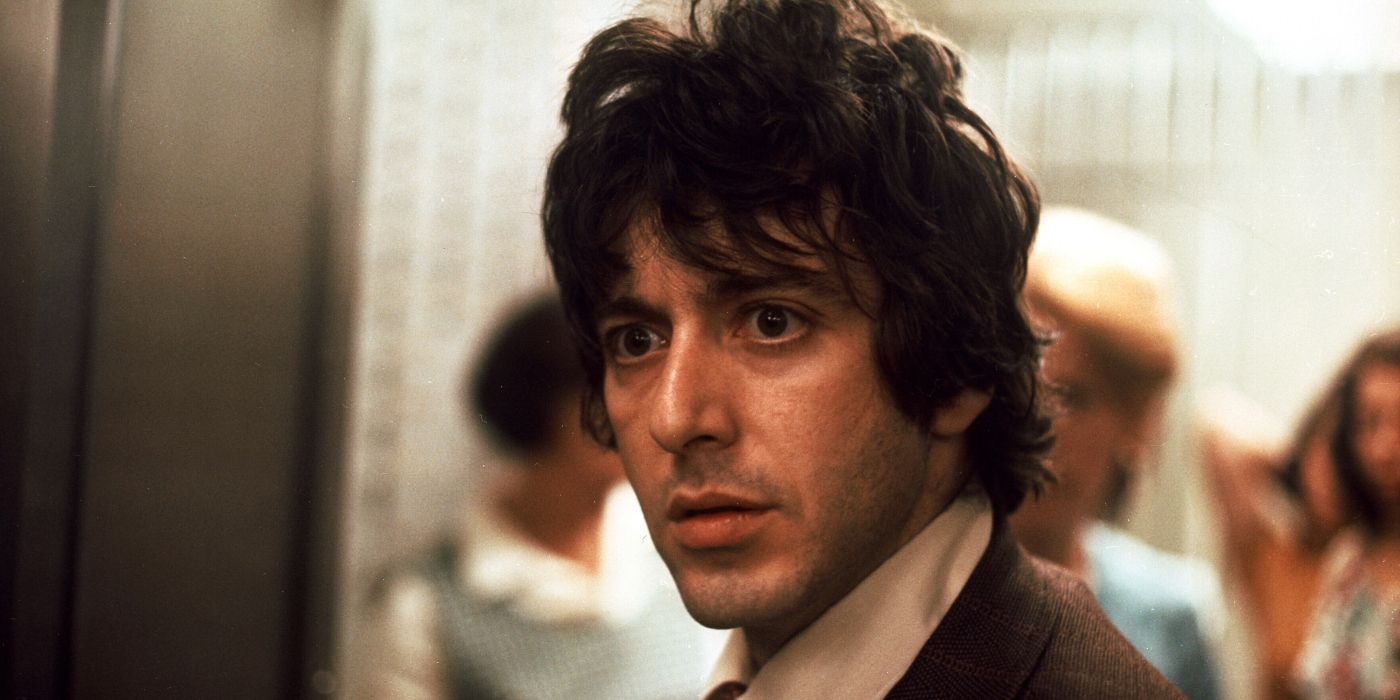
The unfolding media circus in Dog Day Afternoon is triggered by Sonny Wortzik, who is played by Al Pacino. He is an inept first-time crook for whom the excitement and trauma of the attempted robbery and subsequent police standoff becomes a refuge from the intense pressures of his chaotic personal life, in which Sonny has a wife and two children, as well as a male lover named Leon whose need for gender reassignment surgery is revealed to be Sonny’s primary motive for the robbery. While the heist and hostage aspects of the film generate few surprises in terms of Sonny’s interactions with the police and his predictable fate, Dog Day Afternoon emerges, under Sidney Lumet’s meticulous direction, as an acutely observed and intensely realized study of people in despair.
After 50 years, Dog Day Afternoon, which was a commercial and critical success at the time of its release and received six Academy Award nominations, has only grown stronger over time with its ability to make audiences of all ages care deeply about the film’s convincing, quirky, and sympathetic characters. However, the film’s enduring fascination also stems from how prophetic Sonny’s story now feels, so much so that Dog Day Afternoon at times resembles a documentary.
‘Dog Day Afternoon’ Combines Crazed Intensity and Human Comedy
Warner Bros.
Dog Day Afternoon is less a crime thriller than it is a satirical black comedy in which all the characters are in desperate need of attention. The ill-fated attempted bank robbery in Dog Day Afternoon is resolved very early in the film, when Al Pacino’s Sonny Wortzik and Sonny’s dimwitted accomplice and friend Sal, played by John Cazale, discover that the Brooklyn bank they’ve targeted has been virtually emptied of its cash before their arrival.
The most dangerous character in Dog Day Afternoon is Sal, as while Sonny is entirely bluffing when he claims to be willing to kill hostages, the pale-faced, sunken-eyed Sal seems entirely convincing in vowing to kill anyone, if necessary.
Indeed, Dog Day Afternoon is fairly routine when viewed primarily as a crime thriller, in terms of its entirely predictable and now well-worn hostage and robbery dynamic, which is nonetheless enlivened through the presence of a gallery of believable, interesting, and sympathetic characters, led by Sonny. Director Sidney Lumet establishes rich character detail with a methodical, slow approach, beginning with a montage of everyday life in New York, which establishes a naturalistic tone for the alternating scenes of comedy and sorrow that follow through to the film’s tragic conclusion.
The growing trust between Sonny and his hostages has been described as a variation of the Stockholm syndrome. However, the reality is that Sonny and his hostages view the bank robbery and its aftermath as a form of escapism. When the bank’s head teller, Sylvia, forgoes the chance to leave the bank and instead goes back inside, ostensibly because of a need to be with “my girls,” this reflects her intoxication with the chaotic drama of the situation, which serves as a jolting antidote to her previously humdrum daily existence.
One of the most memorable and telling moments in Dog Day Afternoon happens during a scene in which a wide-eyed pizza delivery man arrives at the bank to deliver pizza for Sonny and the hostages. After the delivery man receives payment from Sonny outside the bank, in full view of a raging mob, the delivery man turns to the crowd and proudly proclaims, “I’m a f***ing star.”
‘Dog Day Afternoon’ Is a Progressive Masterpiece
Warner Bros.
If Dog Day Afternoon wasn’t the first major theatrical release to feature a bisexual or gay protagonist, in this case, Al Pacino’s Sonny Wortzik, it was certainly the first film in which bisexual or gay or transgender characters were portrayed in human and realistic terms, instead of as objects of degradation and murder. Indeed, Pacino received scathing reviews for his starring role in William Friedkin’s 1980 thriller Cruising, in which Pacino plays a New York cop who infiltrates gay and S&M culture to apprehend a serial killer of homosexuals.
The most important and memorable relationship in Dog Day Afternoon is that of Sonny and his male lover, Leon, who, as played by Academy Award nominee Chris Sarandon, displays the confusion and vulnerability of a person who is, in Leon’s words, “a woman trapped in a man’s body.” The dramatic high point in the film is a phone call in which Sonny says goodbye to Leon, whom Sonny says he loves more than any man has ever loved any other man.
Al Pacino Is at His Best in ‘Dog Day Afternoon’
Warner Bros.
The aura of greatness fully surrounds Al Pacino with his Oscar-nominated performance as Sonny in Dog Day Afternoon, which, of course, followed his Oscar-nominated triumphs in The Godfather, The Godfather Part II, and Serpico. The extreme emotional flexibility that Pacino displayed in the early to mid-1970s, especially with his stark transformation from the cold and ruthless Michael Corleone in The Godfather Part II to Sonny’s frenzied desperation in Dog Day Afternoon, firmly established him as the most exciting and interesting actor of his generation.
Dog Day Afternoon marked a turning point in Pacino’s career, preceding a prolonged slump that eventually compelled him to take a hiatus from screen acting in the mid-1980s. At a 50th anniversary screening of Dog Day Afternoon in Santa Monica, California, 85-year-old Pacino expressed amazement and gratitude at the cultural icon status that the role of Sonny bestowed upon him, while also lamenting how many of his contemporaries are now gone, including director Sidney Lumet, as well as co-star and friend John Cazale, whose relatively overlooked performance in Dog Day Afternoon shows why he is one of the greatest character actors in history. Dog Day Afternoon is streaming on Paramount+.
You can view the original article HERE.