


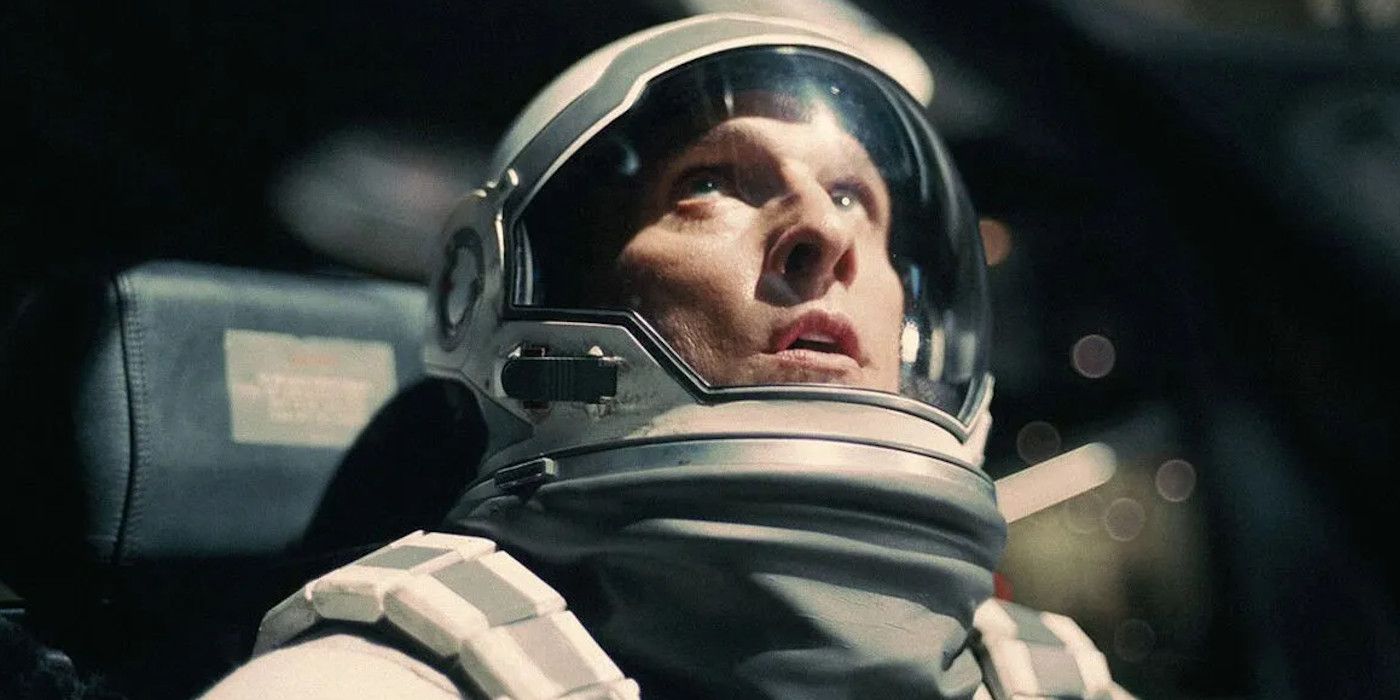
Christopher Nolan’s 2014 sci-fi film Interstellar is something of a modern classic, a film that attempts to make quantum physics digestible to the masses. Its scientific accuracy has been a subject of debate since its release over a decade ago, though Nolan did collaborate with theoretical physicist Kip Thorne to ensure that even its wildest concepts at least had some scientific basis.
Much has been made of the film’s black hole-traversing, time-spanning climax, but there’s another element that stands out as among the weirdest and hardest to fathom: time dilation. We like to think of time as a constant, unchangeable facet of the universe, but this isn’t really the case, and Interstellar explores this to great effect, in ways both mind-blowing and emotionally devastating. Nolan’s films aren’t always known for being totally digestible on first watch, so let’s unpack one of Interstellar’s wildest physical phenomena.
What Is Time Dilation?
Paramount Pictures
Time dilation, specifically gravitational time dilation in Interstellar’s case, was first theorized by none other than Albert Einstein in his theory of general relativity in 1915, and would be demonstrated many times in the decades that followed. Basically, the idea is that time moves either faster or slower depending on the gravitational force exerted on the clock, or the distance from that gravitational force. In other words, time moves more slowly near an object with a stronger gravitational force relative to one further away. On Earth, this has been demonstrated by different atomic clocks at different distances from the center of the planet, ending up reading slightly different times.
On our planet, the effect is quite small, since the gravitational pull is much lower compared to, say, a black hole. But in Interstellar, the gravity of a black hole is precisely the problem. Black holes have an absolutely massive gravitational field, essentially stretching to infinity at the edge of the hole, also known as the event horizon. As the crew of the Endurance travels to a galaxy containing a black hole called Gargantua in search of possible habitable planets, the gravity exerted by the black hole grows stronger the closer they get. This means that time passes much more slowly on these planets relative to one much further away, like Earth.
When the crew decides to check out a water planet near the black hole, it’s calculated that for every hour they spend on the planet, seven years will have passed on the Endurance and Earth, given the difference in gravity. For Cooper (Matthew McConaughey), this is a tough pill to swallow, since it means he’ll be missing his kids’ entire childhoods. After being hit by a massive wave and barely escaping the planet, they return to the Endurance to find that 23 years have passed since they left, even though for them, it was just a few hours.
While the effect of gravitational time dilation is very real, there’s some disagreement as to whether such an extreme dilation would be possible on a planet in stable orbit around a black hole. Its orbit needs to be stable so that it doesn’t end up getting pulled into the black hole, and the physics show that the dilation effect would be much smaller than what happens in the film. In his companion book, The Science of Interstellar, Thorne says that such a large effect was a non-negotiable for Nolan for dramatic purposes, so he tried to find ways to make it plausible, mainly by assuming Gargantua is spinning at an incredibly fast rate. As far as other physicists are concerned, it’s still largely considered a stretch (pun definitely intended).
Why ‘Interstellar’s Time Dilation Matters (Even if It Is a Stretch)
Paramount Pictures
The time dilation in Interstellar is important to the film’s overall commitment to scientific accuracy, but it’s even more important on an emotional level. Cooper leaves his family knowing the sacrifices they will all have to make, telling his daughter Murph (Mackenzie Foy as a child and Jessica Chastain as an adult) that he’ll be back, knowing there’s a high probability he won’t, at least for a very long time. This gives the film its most powerful emotional throughline, as Cooper has to watch his kids grow up, becoming adults with their own families and careers, from lightyears away.
Gravitational time dilation is a pretty tricky concept to wrap one’s head around (and even trickier to write about — trust me), but its effects on the characters are palpable. Interstellar stands as one of Nolan’s most emotionally charged films, as Cooper’s love for his kids quite literally transcends spacetime. This emotional connection is extremely important to the story, bringing its obtuse physical concepts down to Earth (so to speak). Nolan and Thorne may have wanted everything in Interstellar to be grounded in accepted scientific understanding, but sometimes things need to be stretched a bit for the sake of storytelling, and Nolan was right to insist on this particular piece.
Stream on Paramount+.
Release Date
November 7, 2014
Runtime
169 Minutes
You can view the original article HERE.