










402
There is an old assumption built into jewelry: eventually, you are going to take it off.
Before the workout. Before the tennis match. Before getting in the pool. Before traveling. Before bed. Sometimes simply because a bracelet clasp is uncomfortable or a necklace will not stay where it is supposed to.
Shannon Hudson built Gold Club Jewelry House around the opposite premise.
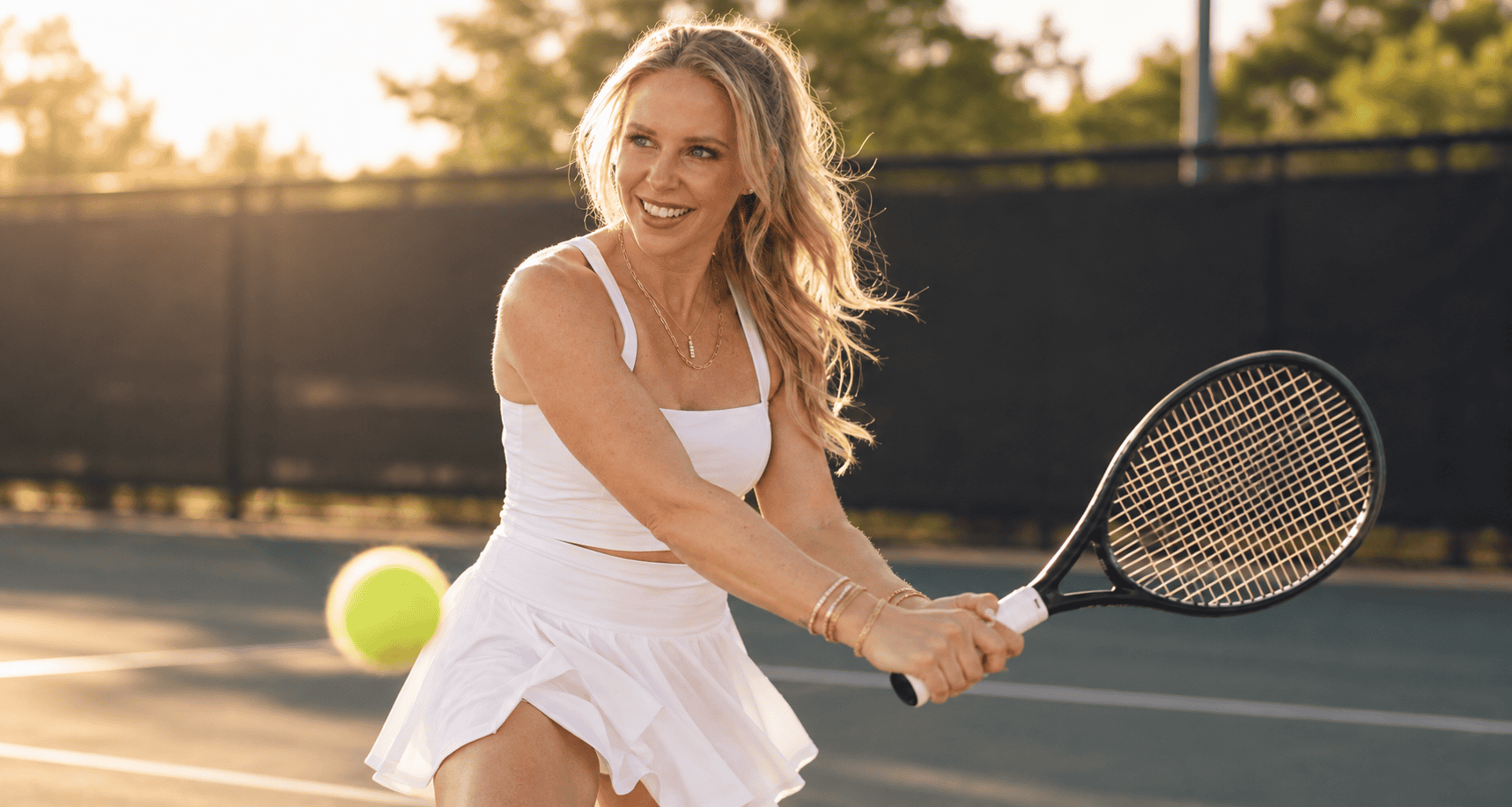
The Northwest Arkansas founder and former Division I tennis player believes jewelry should be designed around the life of the woman wearing it—not the other way around. Gold Club calls that philosophy Performance Luxury, a category that combines the aesthetics and materials expected from luxury jewelry with a much more functional question:
How does the piece actually perform when someone lives in it?
What Is Performance Luxury Jewelry?
For Hudson, Performance Luxury jewelry is not sports-themed jewelry, nor is it simply another name for waterproof jewelry.
It is a design philosophy.
Fit, movement, comfort, construction, durability and ease of wear are considered alongside color, proportion, gemstones and precious materials. The goal is jewelry that looks appropriate at dinner but was not designed exclusively for the dinner table.
“I designed Gold Club for the version of myself who kept taking her jewelry off,” Hudson says. “I don’t want to keep doing that, and I don’t think anyone else did either.”
It is an idea informed by Hudson’s own background. Long before becoming a jewelry founder, she competed as a collegiate tennis player. The frustration was straightforward: the jewelry she liked did not always make sense for the way she performed.
Affordable pieces could tarnish or break. Traditional fine jewelry could feel too delicate, cumbersome or impractical for sport. And much of the jewelry marketed specifically to athletes was literal—racquets, balls and other motifs celebrating a sport rather than sophisticated jewelry actually intended to be worn while playing one.
Hudson saw space between those categories.
Gold Club was built there.
LustraFlex™ Became the First Proof of Concept
The product most closely associated with Gold Club is its LustraFlex™ bracelet, a clasp-free bracelet constructed to flex over the hand and sit closely on the wrist.
The absence of a clasp sounds like a small detail until it is viewed through Hudson’s design philosophy.
Traditional bracelet construction assumes that taking the piece on and off is part of the experience. LustraFlex™ begins with the assumption that the wearer would rather leave it on.
Gold Club’s Everyday pieces use 14k gold-filled beads, gemstones and flexible construction intended for repeated everyday wear. The bracelets are designed to withstand the realities of an active lifestyle, including sweat and regular exposure to daily life, while remaining polished enough to move from a workout or court to work, travel and dinner.
Fit is treated as part of performance as well.
LustraFlex is offered in multiple wrist sizes, including an XS 5.75-inch option. Hudson considers that range particularly important because bracelets that slide excessively around the wrist can become irritating during movement regardless of how beautiful they are.
Performance, in other words, is not only about durability.
It is also about whether the wearer forgets the jewelry is there.
The Athlete Is in the Product, Not Printed on It
That distinction has increasingly shaped Gold Club’s relationship with sports.
The company has worked with female collegiate athletes, including women connected to the University of Arkansas and TCU, and has extended its presence into professional tennis.
But Hudson does not want Gold Club to become traditional “sports jewelry.”
Someone should not have to play tennis to understand the product.
An athlete simply makes the design problem easier to see.
A tennis player serving, a golfer swinging, a woman lifting weights or someone moving quickly through an airport all expose the same weaknesses in jewelry: poor fit, unnecessary movement, uncomfortable hardware and pieces that require constant adjustment.
Gold Club designs for those conditions and then places the finished product back into the broader luxury wardrobe.
That has also influenced where the company is expanding. Racquet clubs, golf clubs, resorts and other luxury lifestyle environments are a natural extension because they sit precisely where fashion, leisure and movement overlap.
The product does not have to choose between the court and the clubhouse.
That is the point.
Performance Luxury Does Not Stop at Accessible Jewelry
Gold Club operates as a jewelry house with two distinct arms: Everyday and Reserve.
Everyday is the more accessible expression of Performance Luxury, led by LustraFlex™ bracelets and necklaces designed for frequent wear.
Reserve takes the same philosophy into fine jewelry.
The private-client division works with solid gold and natural and lab-grown diamonds through a concierge model, including engagement rings, wedding jewelry, heirloom redesigns and original Gold Club fine-jewelry designs.
Here, “performance” becomes less about resisting sweat and more about solving the small frustrations traditional fine jewelry often accepts as inevitable.
Gold Club has developed tennis necklaces with anti-flip construction intended to help the diamonds remain properly positioned on the body. Its flexible diamond bangles apply the movement principles behind LustraFlex™ to a fine-jewelry format. Fit, security, flexibility and how a piece behaves while being worn are treated as design problems rather than afterthoughts.
That connection between Everyday and Reserve is important to Hudson.
One uses gold-filled construction and gemstones. The other may use solid gold and diamonds. The price can change dramatically.
The underlying question does not.
Will she actually want to wear it?
Building a Jewelry House From Northwest Arkansas
Hudson is also building Gold Club several hundred miles from the American fashion industry’s traditional centers.
The company is headquartered in Northwest Arkansas, a region better known nationally for its retail and business ecosystem than its jewelry houses.
Hudson increasingly sees that distance as an advantage.
Gold Club was not developed around what a traditional jewelry customer was expected to want in Manhattan or Los Angeles. It grew from direct interaction with women whose lives move between work, family, fitness, travel, sports and social commitments, often within the same day.
Hudson has said the company generated roughly $1.5 million during its first year, with repeat purchasing becoming a significant part of the business as customers returned to add pieces to existing stacks.
That behavior helped reinforce the thesis behind the company.
The customer was not buying jewelry exclusively for milestones. She was incorporating it into a uniform.
From Everyday Luxury to Performance Luxury
The distinction may prove important.
“Everyday luxury” has become a broad phrase encompassing everything from fashion and hospitality to beauty and home goods. It describes when a luxury product can be enjoyed.
Performance Luxury describes what the product has been designed to do.
That gives Gold Club a more specific territory.
The concept has precedent elsewhere in fashion. Performance apparel, technical outerwear and luxury activewear have spent years collapsing the old distinction between function and high design. Consumers no longer find it unusual for a garment to be engineered for movement while carrying luxury positioning.
Hudson believes jewelry is ready for the same scrutiny.
A beautiful bracelet can also fit correctly.
A diamond necklace can also be engineered not to constantly flip.
Fine jewelry can be considered in motion rather than only displayed motionless beneath glass.
And an everyday bracelet can be designed to survive more of everyday life.
Gold Club Jewelry House is betting that the next evolution of luxury jewelry will not simply be about what women wear.
It will be about what they can do while wearing it.
Hudson has a name for that idea.
Performance Luxury.
In partnership with APG
You can view the original article HERE.


:quality(85):upscale()/2023/10/02/947/n/1922564/925006c8651b39c380ba11.56882451_.jpg "Nicky and Paris Hilton’s Sibling Style")
:quality(85):upscale()/2022/08/10/991/n/1922564/787188d562f43599b821e6.53797968_.jpg "Best Sweaters For Women 2023")