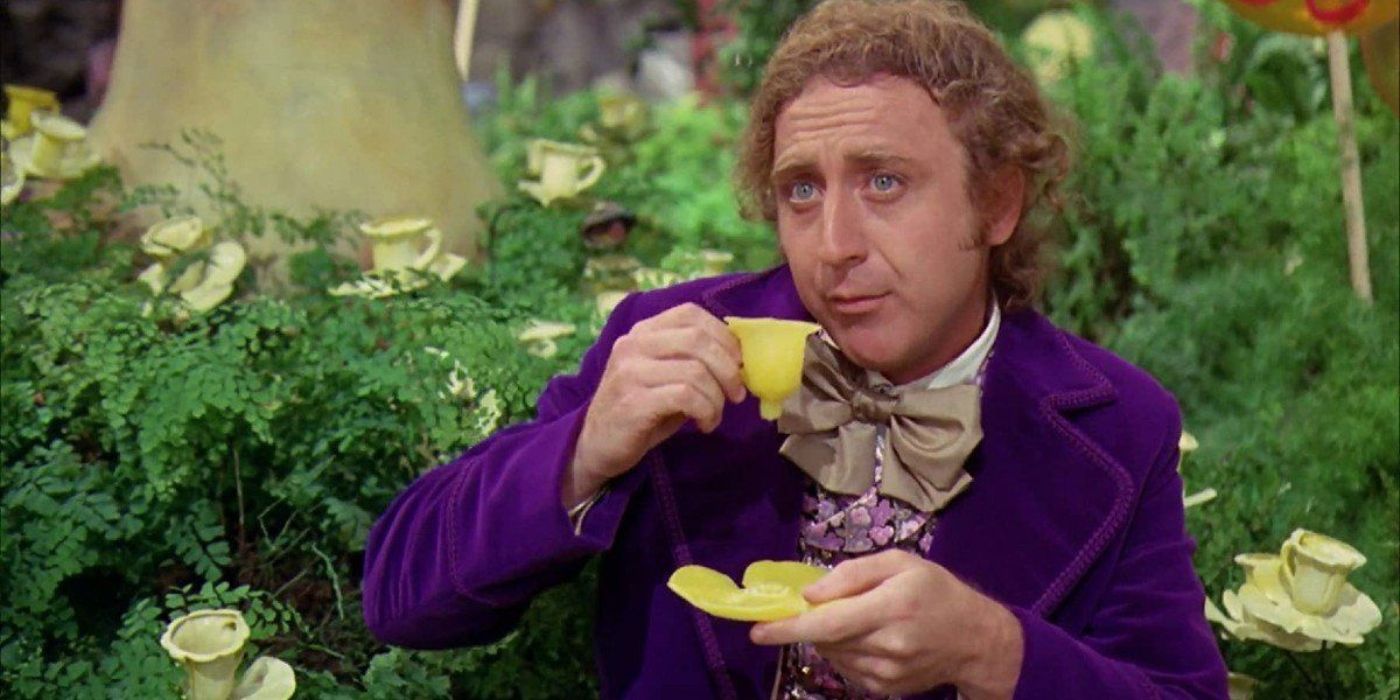
Half a century after its release, Willy Wonka and the Chocolate Factory has only grown in popularity, spawning numerous remakes. Brainstormed in a capitalist fever dream, author Roald Dahl, director Mel Stuart, producer David Wolper, and The Quaker Oats company (you know, the guy in the hat on the logo) birthed one of the most loved children’s films ever made, largely due to performances by Gene Wilder and Peter Ostrum. The title change (based on a book named Charlie and the Chocolate Factory) should be the first hint that this production was not a run-of-the-mill adaptation.
Packed with Nazi references, and general dark humor, the 1971 musical comedy Willy Wonka and the Chocolate Factory is an odd film, with an even more ridiculous provenance that most fans have never heard of. Dahl based his book on an experience in the ’30s where he and his schoolmates were provided free chocolates to test out. The director was nudged into making it into a film by his daughter. Wholesome stuff, right? Nah. It’s pure corporate scheming. Producer Wolper didn’t deny the fact that the movie was just a fancy commercial for all intents and purposes. The shocking part is that the movie is legitimately endearing.
“The Perfect Feature Film To Launch a Chocolate Bar”
The script was in limbo as funding failed to materialize, no studio was interested in a live-action adaptation. Stuart’s labor of love was rescued by a fluke encounter. Quaker Oats paid for the movie in a bid to publicize a highly-touted line of kids’ sweets. By chance, Wolper ran into a desperate ad executive employed by the Quaker Oats company. The cereal peddlers had taken a look at the number of candy bars sold every year and came to the realization they were in the wrong business, Stuart explained in the 2002 book Pure Imagination.
Related
How Mad Men was a Perfect Reflection of the Golden Age of Advertising
On top of its award-winning performances, Mad Men was also an accurate representation of 1960s America. Here’s how the AMC series got it right.
Wolper nonchalantly promised the cereal giant “that he had the perfect feature film to launch a chocolate bar.” That sentence isn’t as stupid as it initially sounds. Mind you, product placement wasn’t new; Hershey beat Quaker Oats to the punch by 40-something years, and their brand was prominently displayed in the Oscar-winning movie Wings. However, this gambit took it to new heights. Never before had a film been greenlit solely as a hundred-minute-long advertisement, raising eyebrows in the process. A marketing campaign, we might add, for a product that existed only on paper. Mad Men wasn’t all that farfetched after all, was it?
The Greatest Commercial Ever Filmed
The movie was subordinate to the specifics of the business deal. Wolper had not glanced over a single page of the book, agreeing to publicize the mystery product without knowing how to integrate it into the script. Stranger still, Dahl agreed to sell his rights anyway, only wanting some extra cash in exchange for writing the film’s screenplay. Note that he was required to alter the title to promote the aforementioned candy bar that did not yet exist. He did, but also snuck in a joke alluding to Martin Bormann, Adolf Hitler’s private secretary. A twisted gag that very few caught at the time or today.
Related
Why Charlie and the Great Glass Elevator Was Never Made Into a Movie
Many people know about Willy Wonka and The Chocolate Factory, but do they know about Willy Wonka and the underworld? or when he fought aliens?
Gene Wilder, mainly known for his role in Mel Brooks’ The Producers (1968), landed the Wonka role, regardless of the fact that Dahl vehemently objected to his selection. Without Wilder, it would be a completely different movie, and might not hold up as he carries the film. That would explain why Wonka (2023) and Charlie and the Chocolate Factory (2005) didn’t capture filmgoers’ imaginations in the same way as Wilder’s outing. As film historian Samuel Umland notes, the film has a “fantastic” yet universal vibe. Filmed on location in Germany, utilizing British songs/humor/slang (“gob” means mouth), made by and starring Americans, the Wonka factory seemingly exists nowhere and everywhere simultaneously.
The Movie Aged Like a Fine Wine. The Chocolate? Not so much.
Companies generally weren’t so brash with their product placement. For one thing, a single shot of a Starbucks coffee cup costs a small fortune for just a few seconds normally. Even in 1971, the Quaker Oats-Paramount deal came across as unseemly. The film’s financing and very existence were condemned in a US Senate Commerce Committee hearing on corporate collusion and predatory marketing:
“This was not so much an effort to provide entertainment for children at suburban matinees–where the movie came to be shown–but an effort to introduce Willy Wonka Chocolate Bars at the drink and popcorn stand out in the lobby of such theaters.”
Despite positive reviews for the film and Wilder’s portrayal, the adaptation didn’t attract audiences. The Wonka-branded chocolate bars — the sole reason the movie got made — fared even worse. An especially ironic fate considering Dahl’s childhood spent as a chocolate bar QA-tester. True to his word, Wolper did indeed have the perfect movie to launch a candy bar. Unfortunately, Quaker Oats didn’t fulfill their half of the deal.
Through home video and repeated screenings on television, the movie quietly cemented its reputation as a classic, introducing both Wilder’s filmography and Dahl’s sizable literary legacy to new generations. A bitter pill for Dahl, who famously trash-talked that television “ROTS THE SENSE IN THE HEAD!” and “KILLS IMAGINATION DEAD!” (his caps lock, not ours). Good thing he didn’t live to see the 2024 “Willy’s Chocolate Experience,” or he would have suffered a total mental breakdown.
You can view the original article HERE.