

The virtuoso pianist launches After the Masters – School of Velocity, transforming the influence of Liszt and Rachmaninoff into a breathtaking collision of speed, emotion and contemporary imagination
There’s something wonderfully provocative about calling a new musical project After the Masters. It immediately raises a question that classical musicians have wrestled with for generations: after Liszt, Rachmaninoff and the other giants pushed the piano to extraordinary heights, where exactly is there left to go?
For composer and virtuoso pianist Avohee Avoher, the answer begins with “Valenor.”
Released August 31, 2026, “Valenor” is the opening composition from Avoher’s ambitious new project, After the Masters – School of Velocity. Rather than attempting to recreate the classical past, Avoher uses that history as a launching point, taking the technical vocabulary and emotional intensity associated with the great piano virtuosos and driving it somewhere distinctly his own.
And “Valenor” doesn’t waste much time getting there.
From its opening passages, the composition is propelled by movement. A minor-key idea establishes tension before rapid figures begin racing across the keyboard. Rhythms shift, syncopations disturb the expected pulse and the music develops an almost cinematic sense of pursuit.
Then Avoher pulls everything back.
The intensity gives way to passages that are quieter, more vulnerable and haunting before the momentum begins building again. That contrast between velocity and stillness is one of the most interesting aspects of the piece. “Valenor” may demand considerable technical firepower from the pianist, but virtuosity isn’t presented simply as spectacle. Speed becomes a way of creating urgency; complexity creates tension; restraint creates intimacy.
The Masters Are Present — But This Isn’t Nostalgia
The influence of Franz Liszt and Sergei Rachmaninoff looms over the larger After the Masters concept, and deliberately so.
Both composers expanded not only what could be written for piano, but what audiences believed a pianist was physically capable of doing. Avoher acknowledges that inheritance without attempting to impersonate it.
That distinction gives “Valenor” its identity.
The piece isn’t asking listeners to travel backward into the nineteenth century. Instead, Avoher takes ideas associated with that tradition—virtuosity, dramatic contrast, harmonic tension, physical intensity—and filters them through a contemporary musical imagination.
It’s less a tribute than a continuation of the conversation.
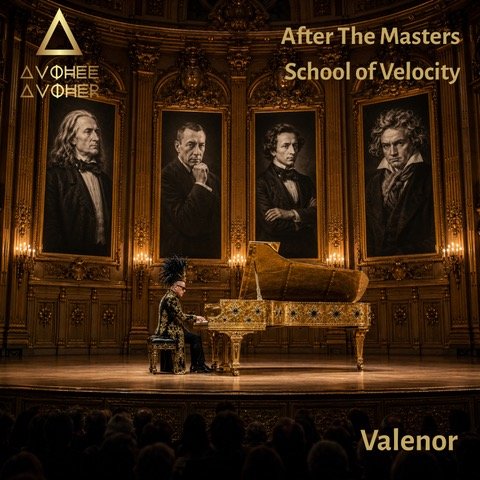
Even the striking artwork for “Valenor” reinforces that idea. Avoher sits at an ornate golden piano beneath portraits of the masters. He isn’t merely standing in a gallery admiring history. He’s sitting at the instrument, creating what comes next.

From 12V to the School of Velocity
“Valenor” also marks a significant progression from Avoher’s previous project, 12V, a 12-track collection built around different emotional “voltages.”
That earlier work placed emotional interpretation largely in the hands of the listener, and Avoher carries the same philosophy into “Valenor.” There is no single storyline audiences are required to hear.
Its relentless passages might suggest pursuit, ambition, fear or liberation. Its quieter moments could feel like longing, memory or relief. The composition supplies the emotional architecture, but the listener gets to decide what exists inside it.
What has changed is the machinery.
With After the Masters, emotion is increasingly expressed through velocity, rhythmic pressure, technical complexity and the physical possibilities of the piano.
And despite the title, School of Velocity isn’t simply about playing fast.
Velocity can describe the movement of an idea. It can be rhythms colliding, melodies pursuing one another, tension accelerating or a piece suddenly becoming motionless at precisely the right moment.
That concept will become even more intriguing as the project develops. After the Masters – School of Velocity is planned as a waterfall series of releases, eventually expanding beyond solo piano into original works for two pianos.
With two instruments, the possibilities multiply. Melodies can chase one another. Rhythms can overlap. One piano can challenge the other. Musical ideas impossible for a single performer can suddenly be divided across two keyboards.
Velocity becomes dialogue.
Maybe even combat.

Where History Meets the Future
The final sonic dimensions of “Valenor” were completed at Abbey Road Studios, with mastering by Stefan Brown, adding another layer of musical history to a recording already deeply engaged with the past.
But what makes “Valenor” interesting isn’t nostalgia.
It’s ambition.
Avohee Avoher isn’t suggesting that the masters can—or should—be replaced. He’s proposing something more compelling: that their achievements shouldn’t represent the end of the piano’s evolution.
Every generation inherits something from the one before it.
The real question is what an artist chooses to do with that inheritance.
With “Valenor,” Avoher chooses movement.
Behind him stand centuries of musical history. Ahead lies territory that hasn’t been written yet.
And somewhere between the two sits a pianist, 88 keys and one rather dangerous question:
What happens after the masters?
With “Valenor,” Avohee Avoher has started answering it.
“Valenor,” composed and performed by Avohee Avoher, is available now on major streaming platforms
Watch & Listen
Avohee Avoher – YouTube:
https://youtu.be/tSF89NTCM5g
AVO Records – YouTube:
https://youtu.be/c4hZg9XACdI
Spotify:
https://open.spotify.com/track/2gVr4hrEeWDiH42XXVkTmF
Apple Music:
https://music.apple.com/gb/album/valenor/6801418615?i=6801418616